
CDCP Braces Coverage is very limited. The plan does not cover cosmetic or routine braces or Invisalign. Only severe, medically necessary cases may qualify, with pre-authorisation and clinical documentation, and rules are still evolving. Always confirm your current coverage before starting treatment.
If you or your child needs braces and you are on the Canadian Dental Care Plan, you are right to ask what it pays for before committing. This guide gives you a clear picture of CDCP Braces Coverage, who may qualify, and how to plan if you do not. For the full background on treatment, see our guide to orthodontic treatment in Woodbridge.
Please Note: CDCP rules are evolving and sources differ on how fully orthodontic coverage is active in 2026. Treat the details below as general guidance and confirm your current coverage with the official Canadian Dental Care Plan and your provider before you plan treatment.
Does CDCP Cover Braces?
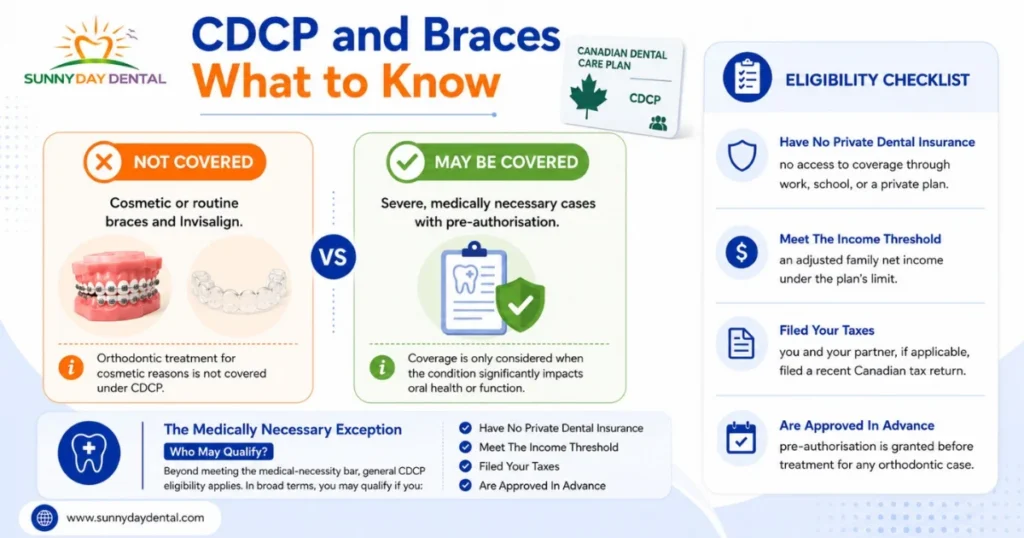
Here is the upfront answer: for most people, no. CDCP braces coverage does not extend to cosmetic or routine orthodontics, so straightening teeth for appearance, or for mild to moderate crowding, is not covered. Braces and Invisalign for those reasons are treated as elective. There is one narrow exception, which we cover next.
The Medically Necessary Exception
The plan may help with CDCP orthodontic treatment in severe, medically necessary cases, where a bite problem seriously affects function like chewing or speech. These cases are assessed against strict clinical criteria, often using a scoring tool such as the HLD Index, and mostly involve children with significant functional issues. Approval requires pre-authorisation through the plan’s administrator and detailed documentation from your dental provider before any treatment begins.
Expert Insight
Medically necessary orthodontic cases are assessed against strict clinical criteria, often using a scoring tool such as the HLD Index, and require pre-authorisation before any treatment begins. Most approved cases involve children with significant functional problems.
Who May Qualify?
Beyond meeting the medical-necessity bar, general CDCP eligibility applies. In broad terms, you may qualify if you:
- Have No Private Dental Insurance: no access to coverage through work, school, or a private plan.
- Meet The Income Threshold: an adjusted family net income under the plan’s limit.
- Filed Your Taxes: you and your partner, if applicable, filed a recent Canadian tax return.
- Are Approved In Advance: pre-authorisation is granted before treatment for any orthodontic case.
Even when a case is approved, co-payments can apply based on income, and a practice may charge above the plan’s set fees, with any difference payable by you.
This is why a CDCP patient guide conversation with your provider matters. Understanding CDCP eligibility and any out-of-pocket cost upfront prevents surprises, and it is exactly the kind of thing we walk through as part of CDCP braces coverage in Woodbridge.

If You Do Not Qualify: Other Ways to Pay
Most people paying for braces will not use CDCP, so it helps to know your other orthodontic payment options. Many private and employer plans cover a share of orthodontics up to a lifetime maximum. Eligible children from lower-income families may have support through Healthy Smiles Ontario. Payment plans spread the cost monthly, and braces are an eligible medical expense on your tax return.
Our braces cost guide for Woodbridge lays out the numbers, and we are a CDCP provider in Vaughan who can check what applies to you.
Check Your Orthodontic Options in Woodbridge
Not sure how CDCP Braces Coverage applies to you? We will help you understand your options and plan a path that works. Book your consultation today.
Sunny Day Dental, Woodbridge. Call (905) 605-5020, visit sunnydaydental.com, or come in at 8290 Highway 27, Unit 4, Woodbridge, ON L4H 0S1. Evening and Saturday appointments available. CDCP accepted.
FAQs About CDCP Braces Coverage
Q1. Does CDCP Cover Braces?
For most people, no. CDCP does not cover cosmetic or routine braces or Invisalign. Only severe, medically necessary cases may qualify, and only with pre-authorisation and clinical documentation. Rules are still evolving, so confirm your current coverage with the official plan before starting treatment.
Q2. Does CDCP Cover Invisalign?
No. Like braces, Invisalign for cosmetic or routine straightening is not covered by CDCP. The plan focuses on essential and medically necessary care, so clear aligners chosen for appearance or mild alignment fall outside coverage. Private insurance or payment plans are the usual ways to fund it.
Q3. Who Qualifies for CDCP Orthodontic Coverage?
Coverage is limited to severe, medically necessary cases that meet strict clinical criteria, plus general CDCP eligibility: no private dental insurance, an income under the plan’s threshold, and a filed tax return. Pre-authorisation is required first. Most approved cases involve children with significant functional problems.
Q4. What Orthodontic Care Might CDCP Cover?
When a case is severe and medically necessary, the plan may help with the orthodontic assessment and braces or appliances for a functionally impairing bite, subject to pre-authorisation. Cosmetic and routine straightening is not included. Confirm current details, as coverage rules are still being defined.
Q5. How Can I Pay for Braces Without CDCP?
Options include private or employer insurance that covers a share up to a lifetime maximum, monthly payment plans, and claiming braces as a medical expense on your tax return. Eligible children may also have support through Healthy Smiles Ontario. Ask your provider for an all-in plan.
Q6. Does CDCP Cover Kids Braces?
Only in severe, medically necessary cases where a child’s bite seriously affects function, assessed against strict criteria and approved in advance. Routine or cosmetic braces for children are not covered. Most families use insurance, payment plans, or provincial programs like Healthy Smiles Ontario instead.