
If you are missing a tooth, or a few of them, you have probably started looking into dental implants in Woodbridge as a way to get your smile and your bite back. Implants have become the gold standard for missing tooth replacement because they look, feel, and work like natural teeth. They are also the only option that replaces the tooth root, which protects your jaw over the long run.
Still, it is a big decision, and you likely have questions. How much do implants cost? Does it hurt? How long does recovery take? Which type is right for you, and will any of it be covered? This guide walks through all of it in plain language, so you can decide your next step with confidence. When you are ready for a personal answer, the team at Sunny Day Dental in Woodbridge is happy to help.
What Are Dental Implants?
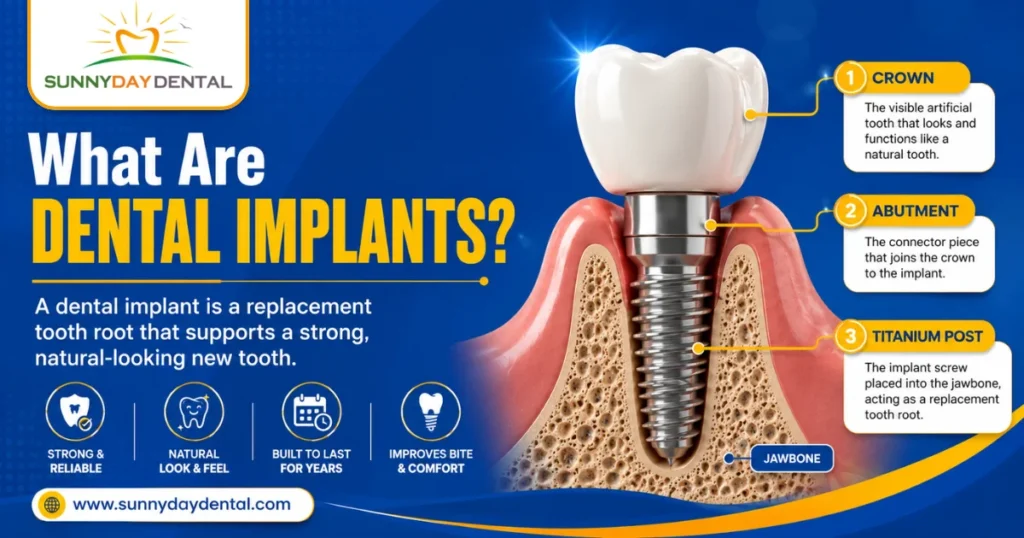
A dental implant is a small titanium post that a dentist places into your jawbone to act as a replacement tooth root. Once it is in, the bone naturally fuses to the surface of the post over a few months in a process called osseointegration. That fusion is what makes an implant so stable. After it has healed, a connector called an abutment is attached, and a custom crown (the visible tooth) is placed on top.
So a complete single implant has three parts: the post in the bone, the abutment, and the crown. That same post can also support a bridge or a denture when more than one tooth is missing, which is why implants are so flexible as a tooth implants treatment for almost any pattern of tooth loss.
Why Replacing a Missing Tooth Matters
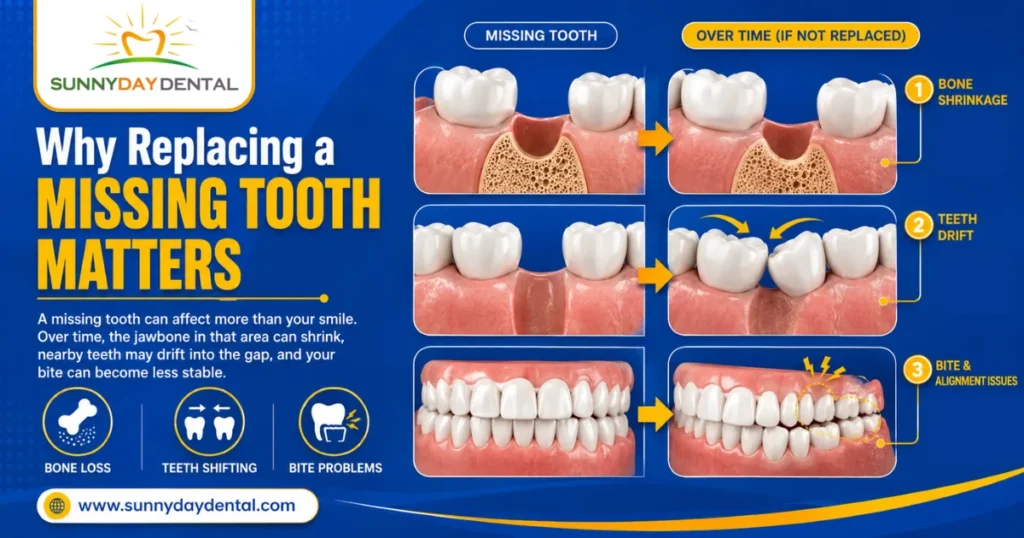
It is easy to ignore a gap, especially a back tooth that does not show when you smile. The trouble is that a missing tooth sets off a quiet chain reaction in your mouth.
- Bone loss: When a tooth is gone, the jawbone in that spot no longer gets pressure from chewing, so it slowly shrinks. Studies suggest you can lose a meaningful amount of bone volume in the first year alone.
- Shifting teeth: Neighbouring teeth start to drift and tilt into the empty space, and the tooth above or below can grow longer to fill the gap. This can throw off your bite.
- Extra wear and strain: As your bite changes, some teeth take more force than they should, which can lead to wear, cracks, and jaw discomfort.
- Function and confidence: Chewing on one side and hiding your smile both take a toll over time.
The reason dentists encourage you to replace a missing tooth sooner rather than later is simple. An implant does not just fill a hole, it preserves the bone and keeps the rest of your teeth where they belong. Acting early often means a simpler, less expensive treatment down the road.
Types of Dental Implants
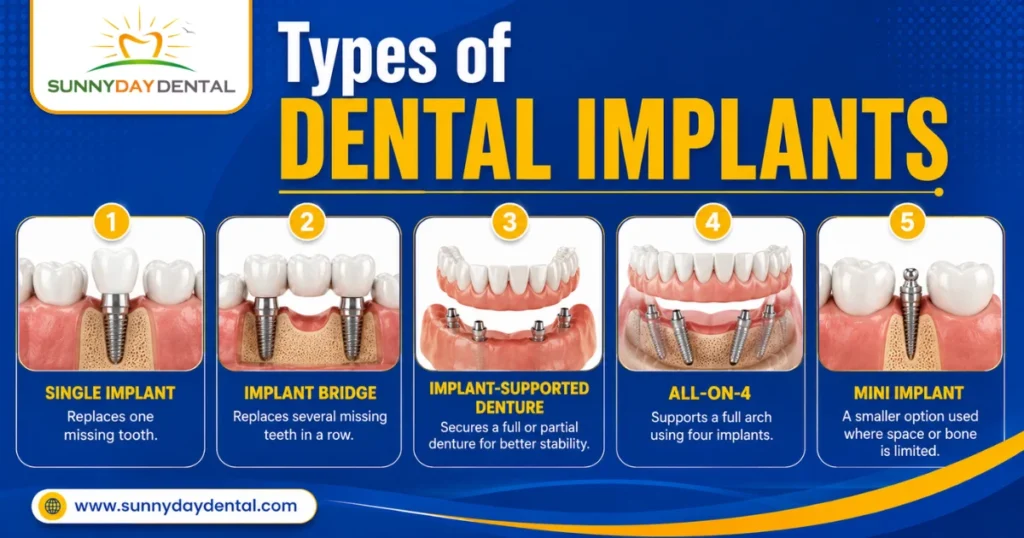
There is no single implant that fits everyone. The right choice depends on how many teeth are missing and how much healthy bone you have. Here are the main types of dental implants used today.
Single Tooth Implant
This replaces one missing tooth with one post and one crown. A big advantage over a traditional bridge is that the dentist does not have to grind down the healthy teeth on either side. It stands on its own.
Implant-Supported Bridge
When you are missing a few teeth in a row, a couple of implants can anchor a fixed bridge. You get a set of connected replacement teeth without relying on your natural teeth for support, and nothing slips when you eat or talk.
Implant-Supported Dentures
A traditional denture rests on the gums and can move around. An implant-supported denture snaps onto a small number of implants instead. It stays put, needs no adhesive, and can still be removed for cleaning. For many people this is a huge comfort upgrade.
All-on-4 and All-on-X Implants
If you are missing most or all of your teeth in an arch, All-on-4 dental implants use just four well-placed posts to support a full, fixed set of teeth. The All-on-X approach uses a similar idea with a different number of implants based on your needs. Both can give people a complete smile in fewer appointments than placing an implant for every single tooth.
Mini Dental Implants
In certain cases, or when there is limited bone, mini dental implants may be an option. They are smaller and less invasive, but they are not the right fit for everyone. An exam is the only way to know.
Not sure which of these fits your situation? That is exactly what a consultation is for. An implant dentist in Woodbridge will look at your bone, your bite, and your goals before recommending a type.
The Dental Implant Process, Step by Step
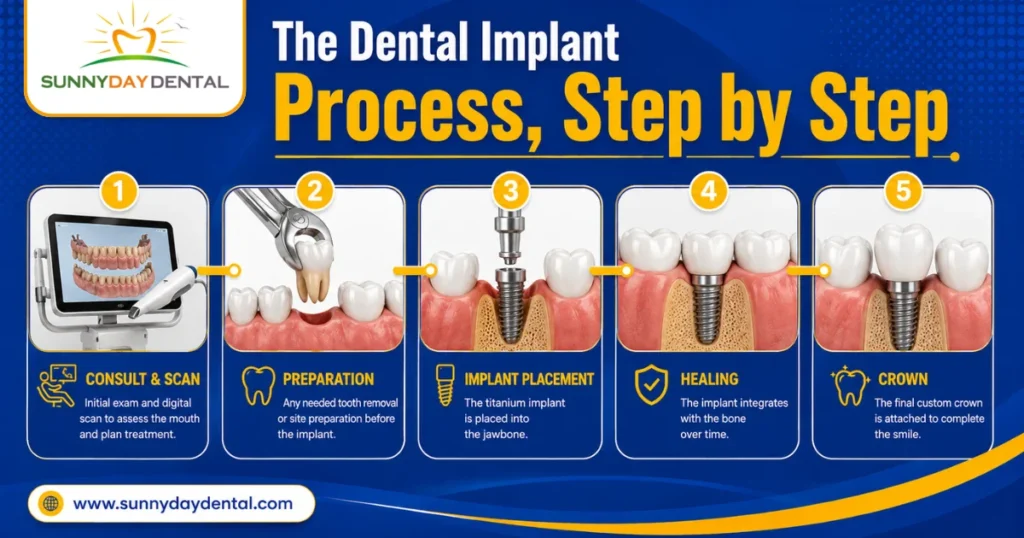
Knowing what to expect takes a lot of the worry out of the process. While every case is a little different, most implant journeys follow these stages.
- Consultation and scan. Your dentist examines your mouth, takes 3D images, and checks the health and amount of your jawbone. You get a clear treatment plan and cost estimate.
- Preparation if needed. Sometimes a tooth needs to come out first, or the bone needs to be built up with bone grafting before an implant can be placed.
- Implant placement. The titanium post is placed into the jawbone during a procedure done under local anesthesia. Most people are surprised by how routine it feels.
- Healing and osseointegration. Over the next few months the bone fuses to the implant, creating a stable foundation.
- Abutment and crown. Once healed, the abutment is attached and your custom crown, bridge, or denture is fitted. This is the moment your new tooth becomes part of your smile.
Dental Implant Recovery: What the Timeline Really Looks Like
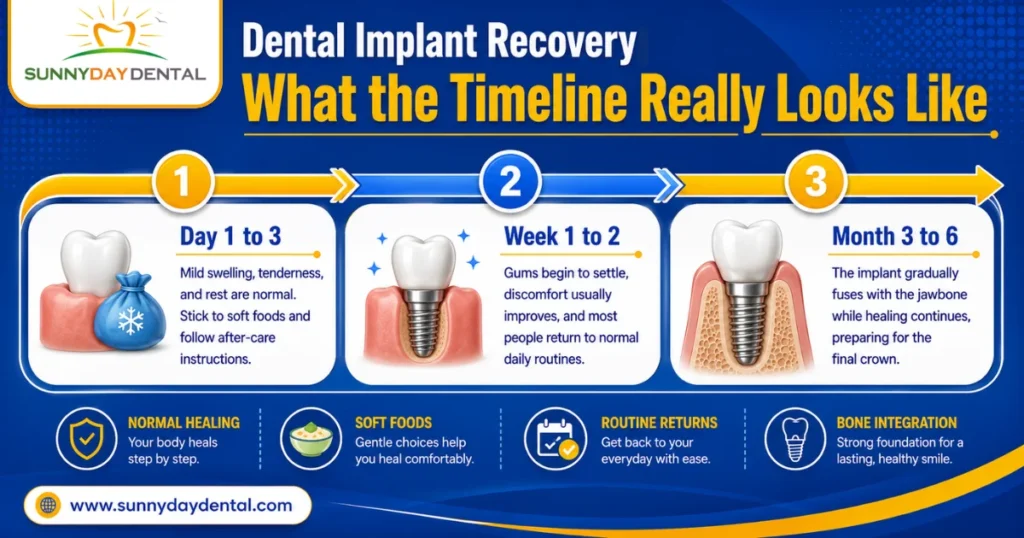
Worry about pain and downtime stops a lot of people from moving forward, so let us be clear about what dental implant recovery actually involves. The good news is that the placement itself is done while the area is fully numb, and most patients describe pressure rather than pain.
- First 24 to 72 hours: Some swelling and mild soreness are normal. Rest, soft foods, and any guidance from your dentist make this stretch easy to manage.
- First one to two weeks: Discomfort fades and most people return to their normal routine quickly. Many say it felt easier than a tooth extraction they had already been through.
- Three to six months: This is the quiet healing phase where the implant fuses to the bone beneath the surface. You are not in pain during this time, the work is simply happening underneath.
If you need a bone graft first, the overall timeline is longer, since the graft needs its own healing window before the implant goes in. Your dentist will give you a realistic schedule based on your case. The key thing to remember is that a little patience during healing is what gives you a result that can last for decades.
How Much Do Dental Implants Cost in Woodbridge?
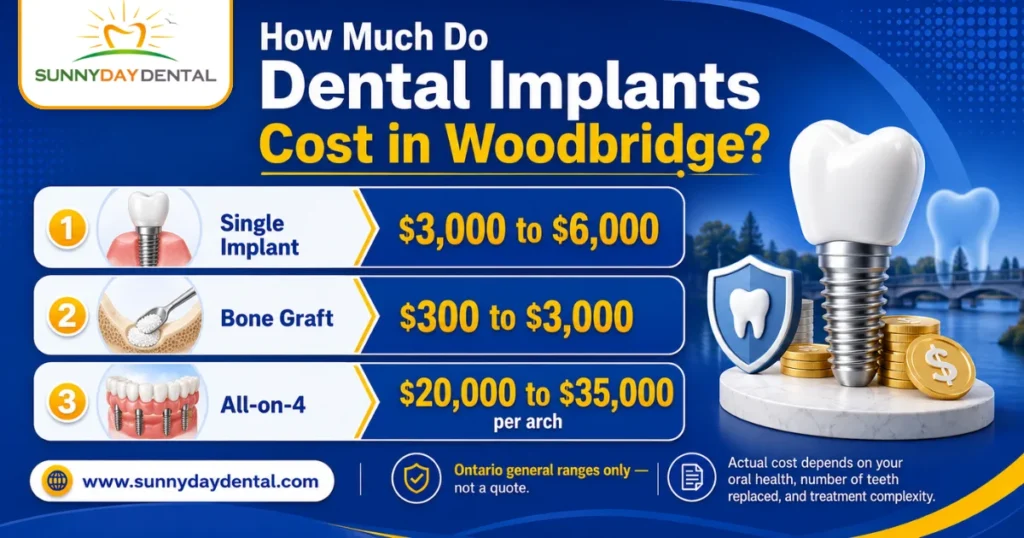
Cost is usually the first question, and the honest answer is that there is no single flat price. The dental implants cost depends on the type of implant, the condition of your jaw, and whether you need any extra steps like a graft. As a general guide for Ontario:
- A single dental implant (post, abutment, and crown) commonly falls in the range of about $3,000 to $6,000 for the complete restoration.
- Bone grafting, when needed, often adds roughly $300 to $3,000 depending on how much is required.
- Full-arch options like All-on-4 are a larger investment, frequently in the range of about $20,000 to $35,000 per arch, but they replace an entire set of teeth.
These are general ranges to help you plan, not a quote. The only way to get an accurate number for your mouth is a proper exam and a written treatment plan. It also helps to remember the other side of the math: leaving a gap can lead to bone loss and shifting teeth, which often means more complex and costly treatment later. In that sense, acting sooner can be the more affordable choice.
Does Insurance or CDCP Cover Dental Implants?
This is an area where it pays to know the facts. Provincial health coverage (OHIP) does not pay for dental implants. Private dental insurance sometimes covers a portion, but annual maximums are usually well below the full cost of an implant, so most people pay a meaningful share out of pocket.
As for the Canadian Dental Care Plan (CDCP) it is important to be upfront: the CDCP generally does not cover dental implants, because implants are classified as an elective or specialized procedure. What the CDCP can help with are many of the services around your care, such as exams, cleanings, fillings, extractions, and covered tooth-replacement alternatives like dentures. Sunny Day Dental is a proud CDCP provider in Vaughan, so if you qualify, we can help you make the most of the coverage you do have and walk you through your options for the rest. Coverage details can change, so the best move is to ask us to check what applies to your specific situation.
The Long-Term Benefits of Dental Implants
When people weigh the cost, it helps to look at what they are actually buying. The benefits of dental implants go well beyond appearance.
- They protect your jawbone. Because the implant replaces the tooth root, it keeps stimulating the bone and helps prevent the shrinkage that comes with a missing tooth.
- They feel and function like natural teeth. You can eat the foods you love and brush and floss normally, with no removing or soaking.
- They are built to last. Dental implants have a high success rate, often cited at over 95 percent, and with good care they can last for decades.
- They protect your other teeth. Unlike a traditional bridge, a single implant does not rely on grinding down the healthy teeth beside it.
- They restore confidence. A stable, natural-looking tooth means no more hiding your smile or worrying about something slipping.
Are You a Candidate for Dental Implants?
Most healthy adults with one or more missing teeth are good candidates. A few things your dentist will look at include the amount and quality of your jawbone, your gum health, and your overall health and habits.
A common question is whether smokers can get implants. The short answer is usually yes, but smoking does slow healing and raises the risk of an implant not integrating as it should, so it calls for careful planning. Conditions like uncontrolled diabetes or gum disease are also worth addressing first. None of these are automatic disqualifiers. They simply shape the plan. The best way to find out where you stand is a no-pressure consultation.
Implants vs Dentures: A Quick Comparison
If you are choosing between implants and dentures, it helps to know what each does best. Traditional dentures cost less up front and can be made quickly, which is a real advantage for some people. Implants cost more at the start but feel more like natural teeth, protect the jawbone, and tend to need less fuss over the years. There is no universal winner. The right answer depends on your bone, your budget, and your lifestyle, which is something a dentist can help you sort out in person.
Caring for Your Dental Implants
One of the best things about implants is how simple they are to look after. You care for them much like your natural teeth, and good habits are what help them last for the long haul.
- Brush and floss daily. Implants cannot get cavities, but the gum and bone around them still need healthy, plaque-free conditions to stay strong.
- Keep up with checkups and cleanings. Regular visits let your dentist catch any issue early and keep the tissue around the implant healthy.
- Avoid using your teeth as tools. Cracking ice or opening packaging can damage the crown, just as it can a natural tooth.
- Mention any concerns. If an implant ever feels loose or the area becomes sore, let your dentist know promptly.
Book Your Dental Implant Consultation in Woodbridge
A missing tooth will not fix itself, and the sooner you explore your options, the simpler the path tends to be. Whether you need a single tooth replaced or a full-arch solution, the team at Sunny Day Dental is here to help you understand your choices with no pressure. Book your consultation today and take the first step toward a smile that feels like your own again.
Why Choose Sunny Day Dental in Woodbridge

Choosing the right team matters as much as choosing the right treatment, because skill and planning are what give implants their best chance of lasting. With over 25 years of combined experience, the dentists at Sunny Day Dental take the time to listen, explain everything clearly, and build a plan around your goals and your budget. We offer the full range of implant solutions in one place, from single implants to All-on-4, and we are a CDCP provider with hours that fit busy schedules. If dental anxiety is something you deal with, tell us, and we will go gently.
Frequently Asked Questions About Dental Implants in Woodbridge
1. How long do dental implants last?
With good oral hygiene and regular checkups, implants can last many years, often decades. The crown on top may eventually need replacing, but the implant post itself is designed to be a permanent solution.
2. Is the implant procedure painful?
The placement is done with local anesthesia, so you should not feel pain during it. Afterward, most people have only mild soreness for a few days that is easy to manage.
3. How long is the whole process?
From placement to final crown, many cases take about three to six months because the bone needs time to fuse to the implant. If bone grafting is needed first, it can take longer.
4. Can I get all my teeth replaced with implants?
Yes. Full-arch solutions like All-on-4 can replace an entire upper or lower set of teeth using just a few implants.
5. Can smokers get dental implants?
Usually yes, though smoking slows healing and raises the risk of an implant not fusing properly, so it calls for careful planning and honest conversation. It is rarely an automatic no.
6. How do I know which option is right for me?
The only reliable way is an exam and 3D scan so your dentist can assess your bone and bite. From there you get a clear recommendation and cost estimate.